In short
- Sales are still growing: revenue was up 62% in the quarter to June, most of it from Space Systems.
- Neutron's first launch moved from late 2026 to 2027; the first target, set in 2021, was 2024.
- On my sum, about $1.2B is left after buying Iridium in mid-2027, before the cash Rocket Lab uses until then; Iridium's $1.8B loan comes with it.
- About 8% more shares are already agreed (Iridium deal, forward sale, convertible debt); about 10% by spring 2028 with staff awards at their recent pace.
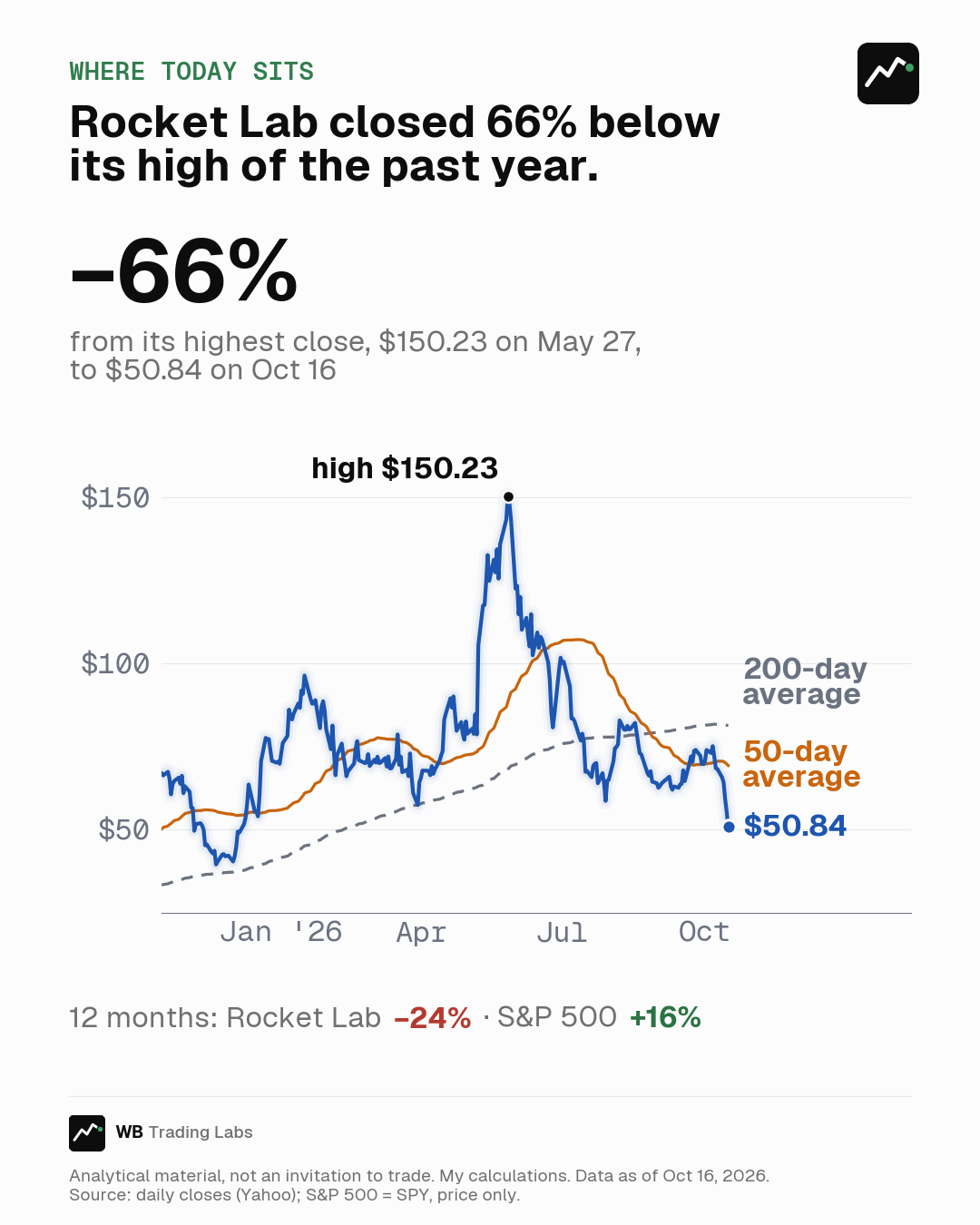
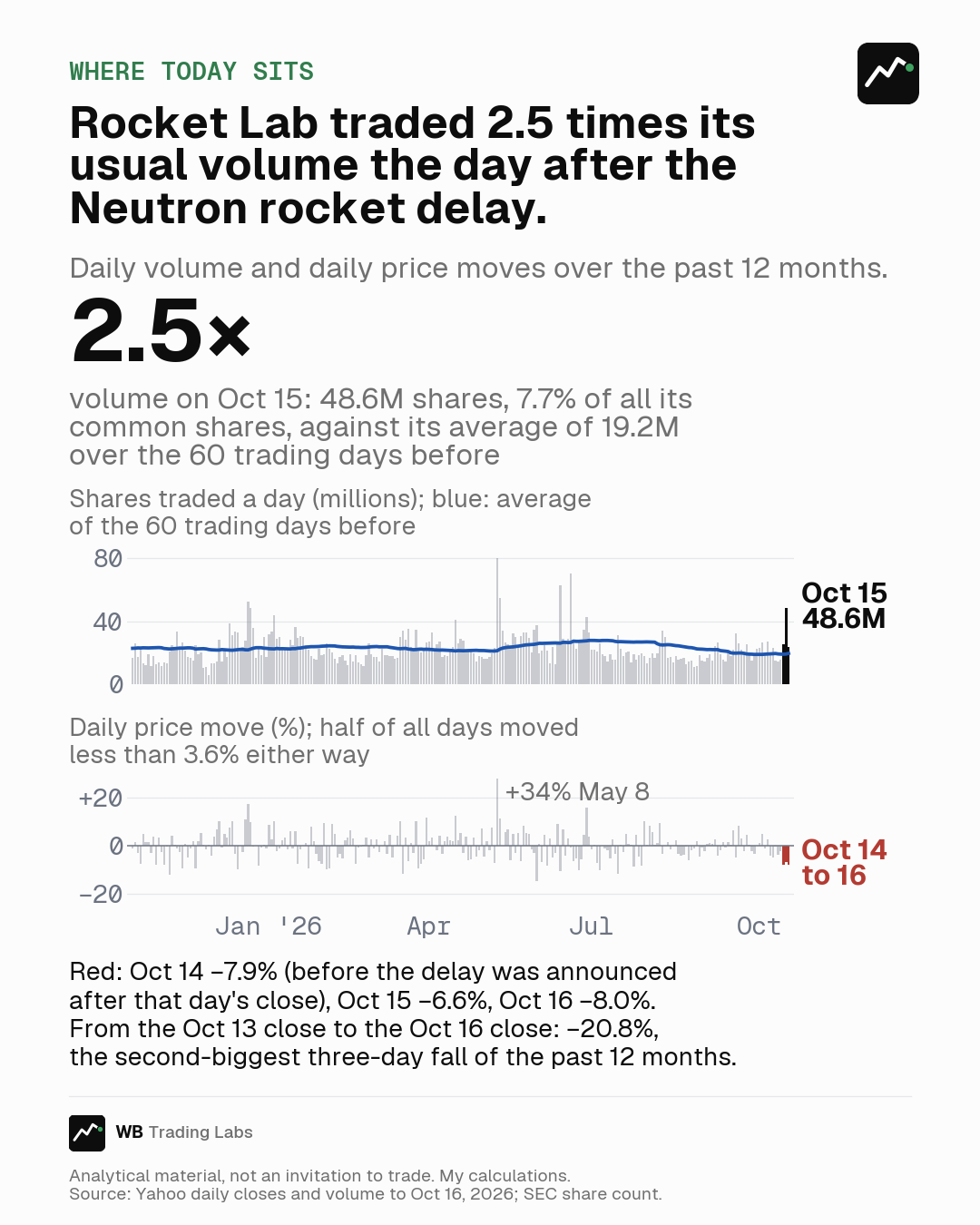
The stock closed 66% below its May high on 16 October, and 14% below its close on 14 October, the day Rocket Lab moved its Neutron rocket's first launch to 2027 (announced after that day's close). Sales grew: revenue was up 62% year on year in the quarter to June.
So I looked at what did change: when the new rocket starts earning, the cash left after the planned Iridium purchase, and the share count.
Sources: daily closes (Yahoo) to 16 October 2026; 10-Q, June 2026; 8-K, 14 Oct 2026.
Where it grows
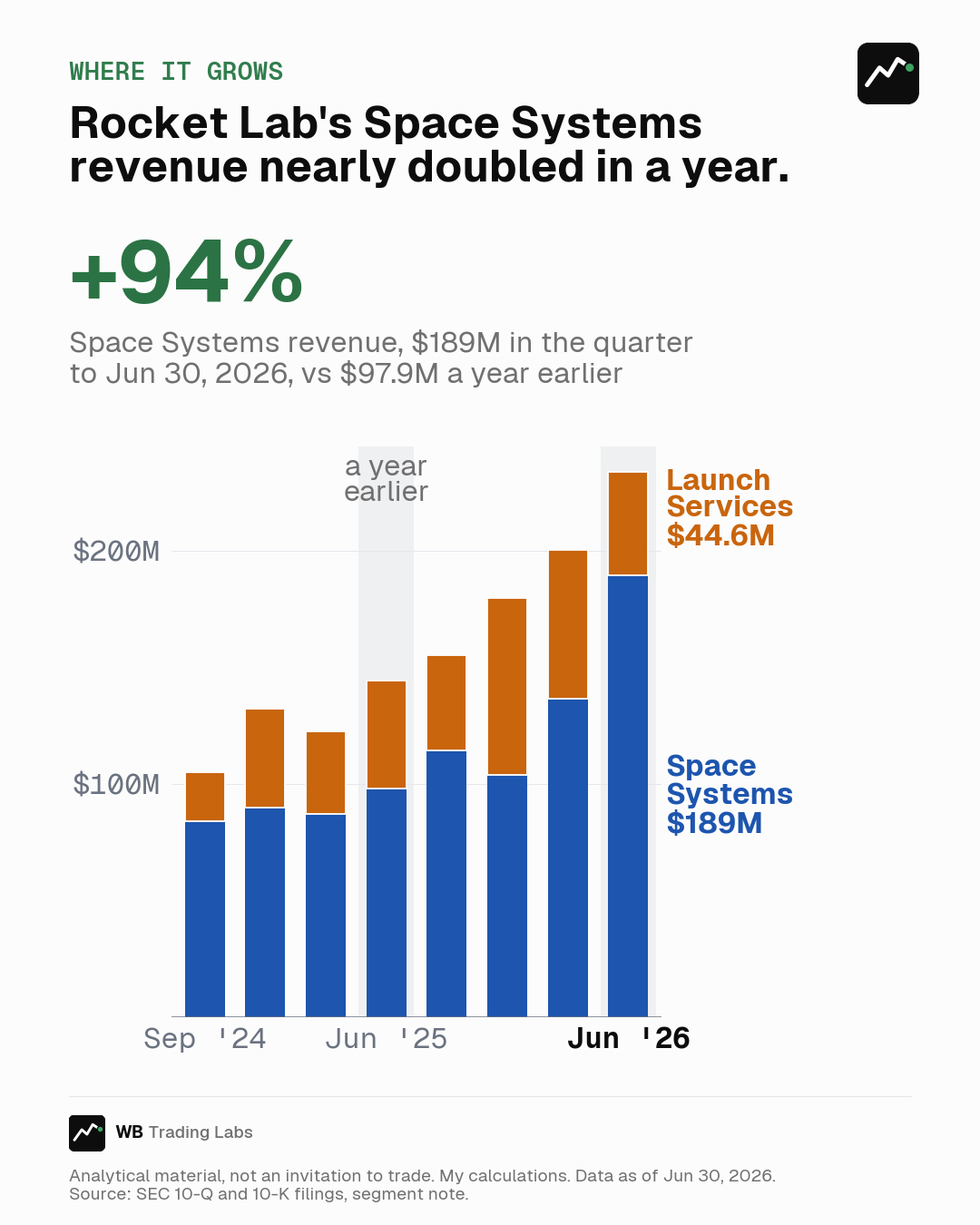
The growth is in Space Systems (satellites and their parts): $189M in the quarter to June, up 94% in a year. Launch revenue fell two quarters in a row, from $75.9M to $44.6M, 4% below the same quarter a year earlier. Over the 12 months to June, launch revenue is still up 55% on the 12 months before.
Sources: segment notes: 10-Q, June 2026, 10-Q, March 2026, 10-Q, Sep 2025 and 10-K for 2025.
Electron, the rocket flying today
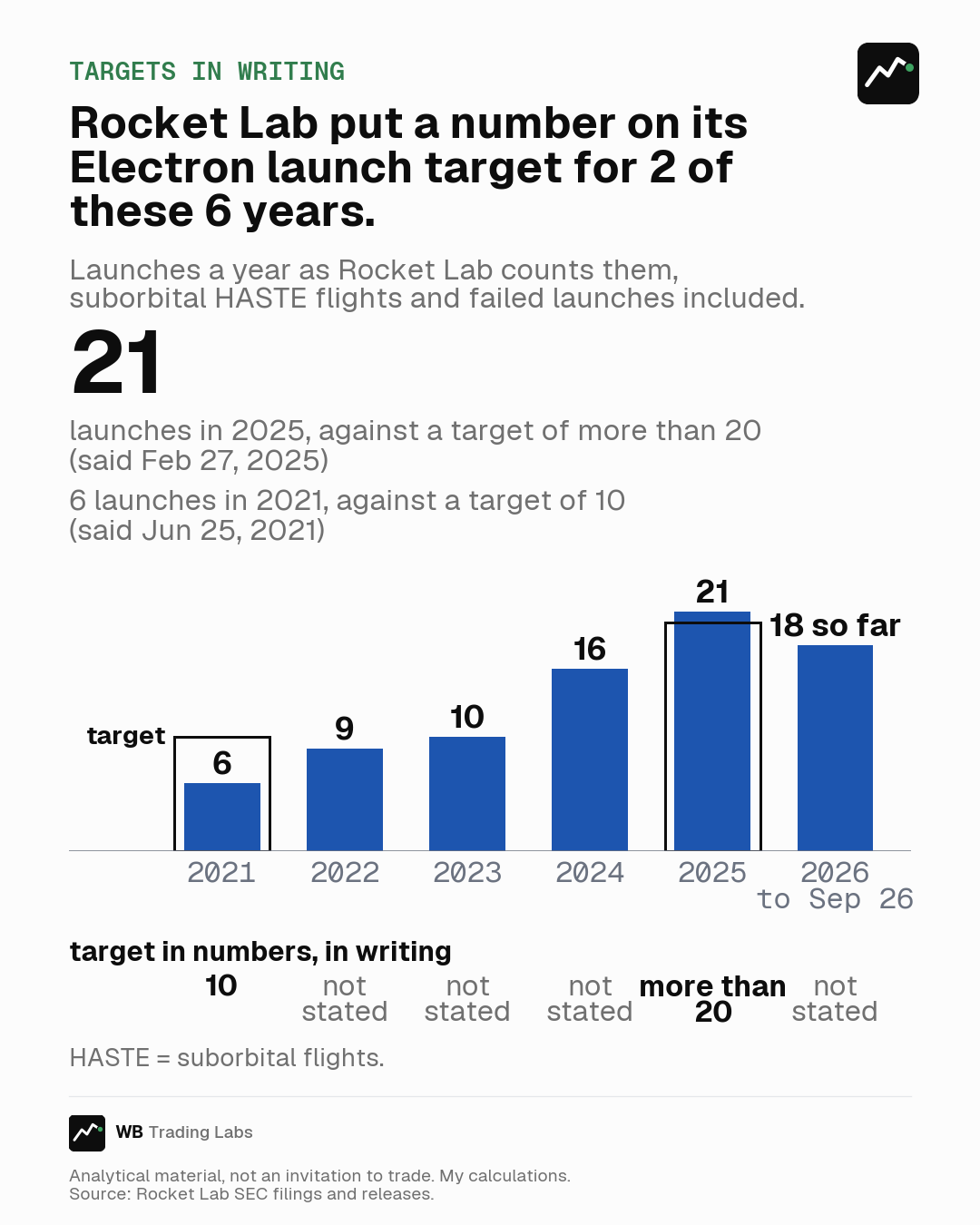
The other segment, launch, earns mainly from Electron, Rocket Lab's small rocket (the rest includes contract termination and study revenue). It flew 16 times in 2024 and 21 times in 2025, suborbital HASTE flights included. Each launch brought in $7.8M on average in 2024 and $8.5M in 2025, while the cost per launch fell from $5.7M to $4.8M. In the first half of 2026 Electron flew 12 times, at $9.2M per launch against $7.5M a year earlier, and a cost of $4.9M against $5.3M.
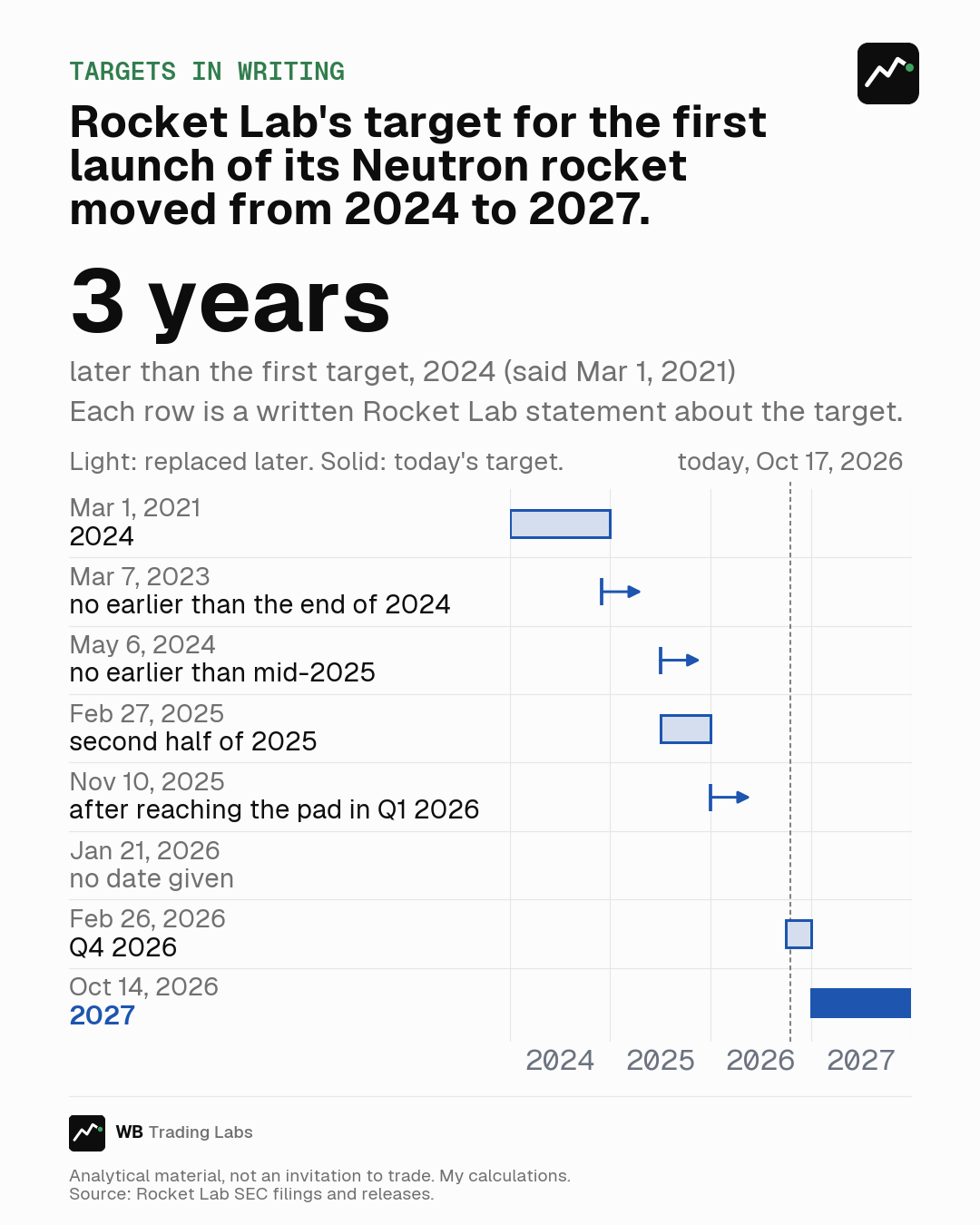
Launch revenue still moves from quarter to quarter. In the June quarter it fell 4% from a year earlier although launches rose from 5 to 6: two of them were HASTE flights, with revenue counted partly in earlier quarters, the company says. Rocket Lab put a number on its Electron target for two years: 10 launches for 2021 (it launched 6, one of which failed) and more than 20 for 2025 (it flew 21). The chart below sets Electron's launches against those written targets; the next one does the same for Neutron's first-launch date.
Sources: 10-K for 2025; 10-Q, June 2026; S-4, 2021; 8-K, Feb 2025.
Neutron's first launch
Neutron, the bigger rocket meant to grow the launch side, was announced on 1 March 2021 with a first launch expected in 2024. In its annual report of 26 February 2026 Rocket Lab still said the fourth quarter of 2026; on 14 October it moved the first launch to 2027.
Sources: 8-K, 1 Mar 2021; 10-K for 2025; 8-K, 14 Oct 2026.
The launch market
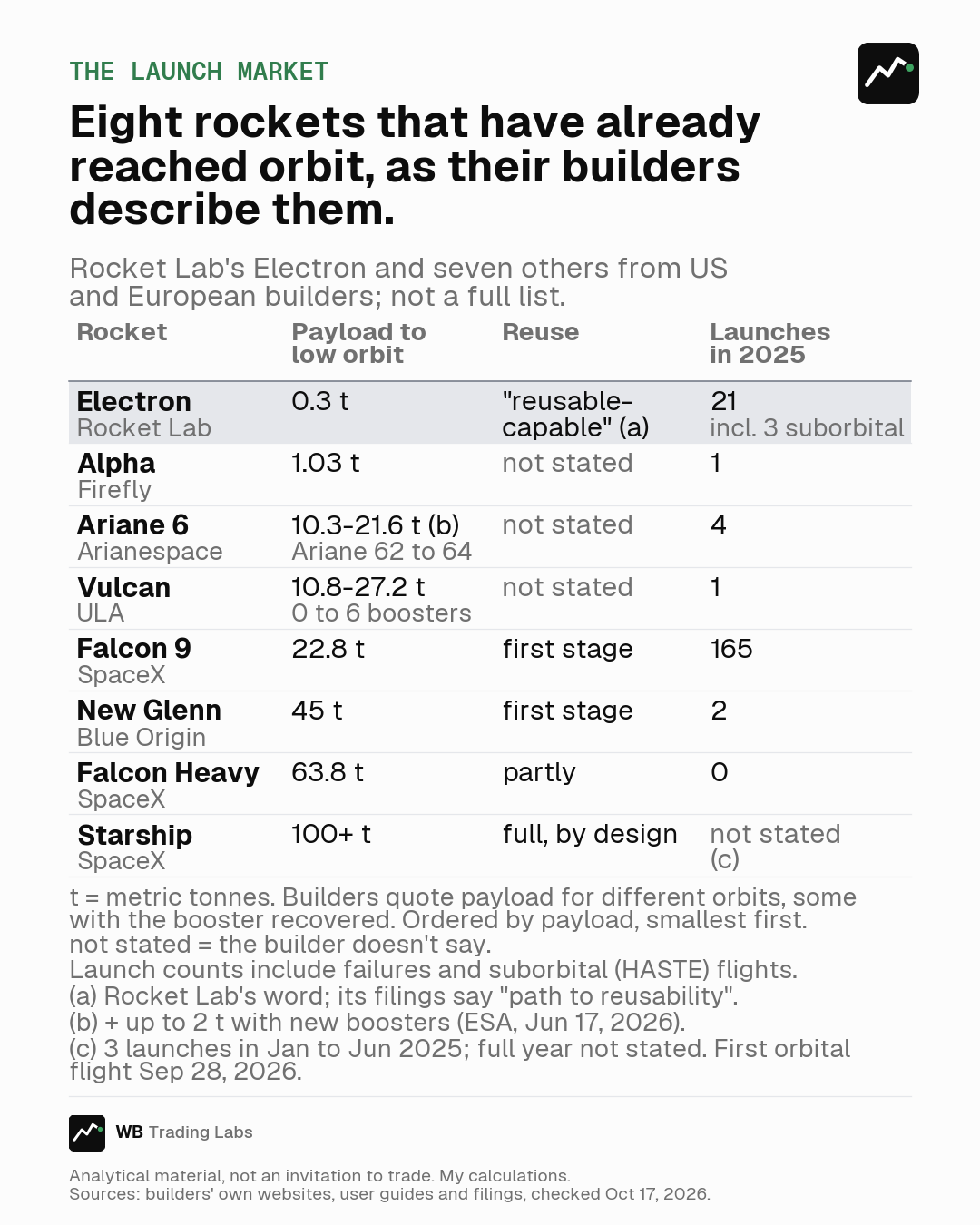
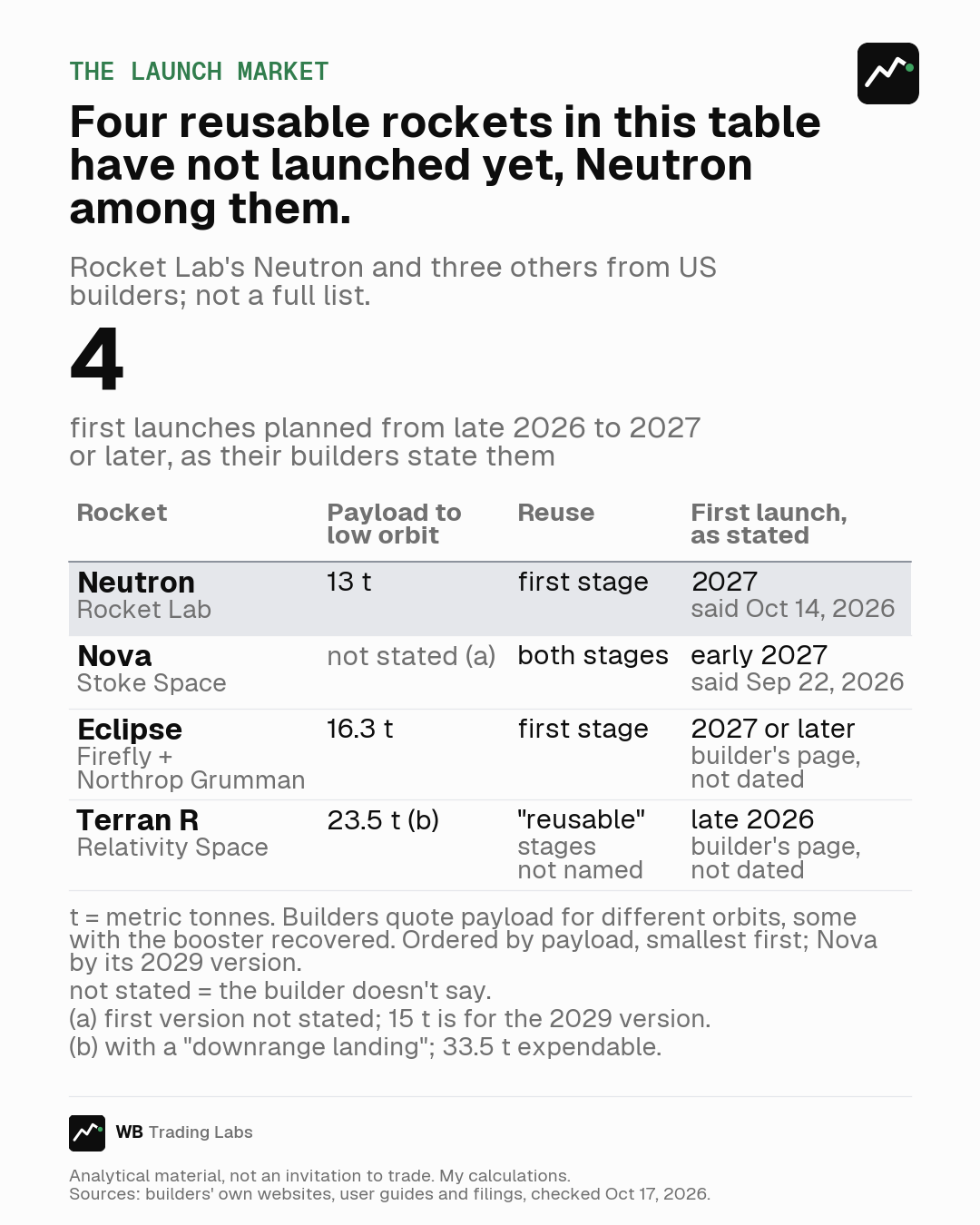
Where Neutron would sit: eight rockets that have already reached orbit, and four reusable ones that have not launched yet, Neutron among them. Neutron's planned 13 tonnes to low orbit, with its booster recovered, is in the range of Ariane 6 and Vulcan and below the 22.8 tonnes SpaceX lists for Falcon 9. The three other reusable rockets in the second table below plan first launches from late 2026 to 2027 or later. Each is described from its space company's own figures and words; neither table is a full list.
Sources: space companies' own websites, user guides and filings, checked 17 October 2026.
Backlog
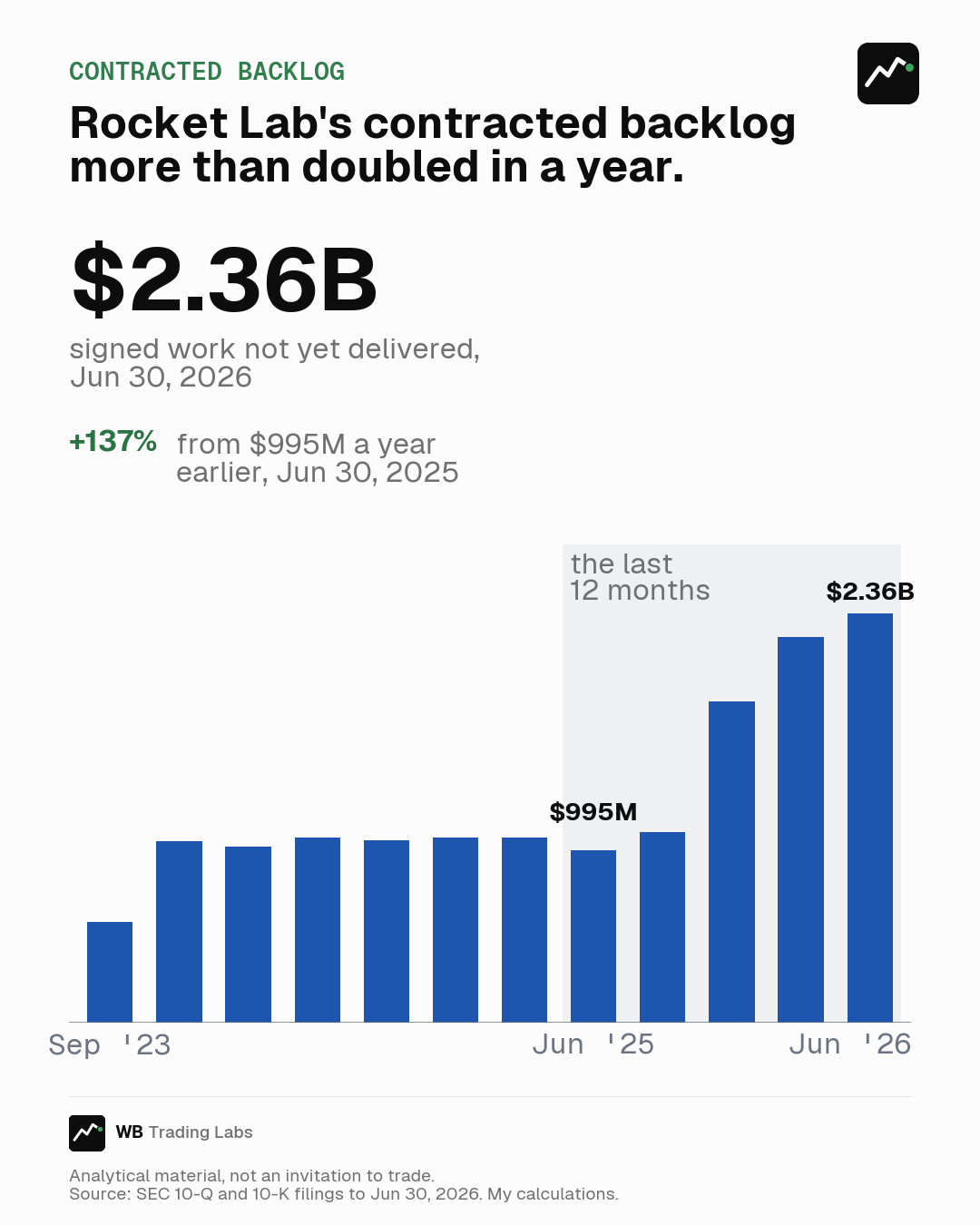
Backlog was $2.36B at the end of June, about three times the last 12 months' sales ($769M). The biggest single piece is an $816M contract from the US Space Development Agency for 18 satellites, the last delivered in 2029, which either side can end at any time without cause ("for convenience").
In the first quarter of 2026 launch backlog nearly doubled, from $476M to $921M, including five Neutron launches; the filings don't say how much of it is Neutron. Space Systems backlog dipped in the same quarter, from $1.37B to $1.30B. By June both were higher: $940M launch and $1.42B Space Systems. 45% of the whole backlog, about $1.06B, is due within the next 12 months.
Sources: 10-Q, June 2026; 10-Q, March 2026; 8-K, 7 May 2026, results; 8-K, 19 Dec 2025.
Cash after the Iridium purchase
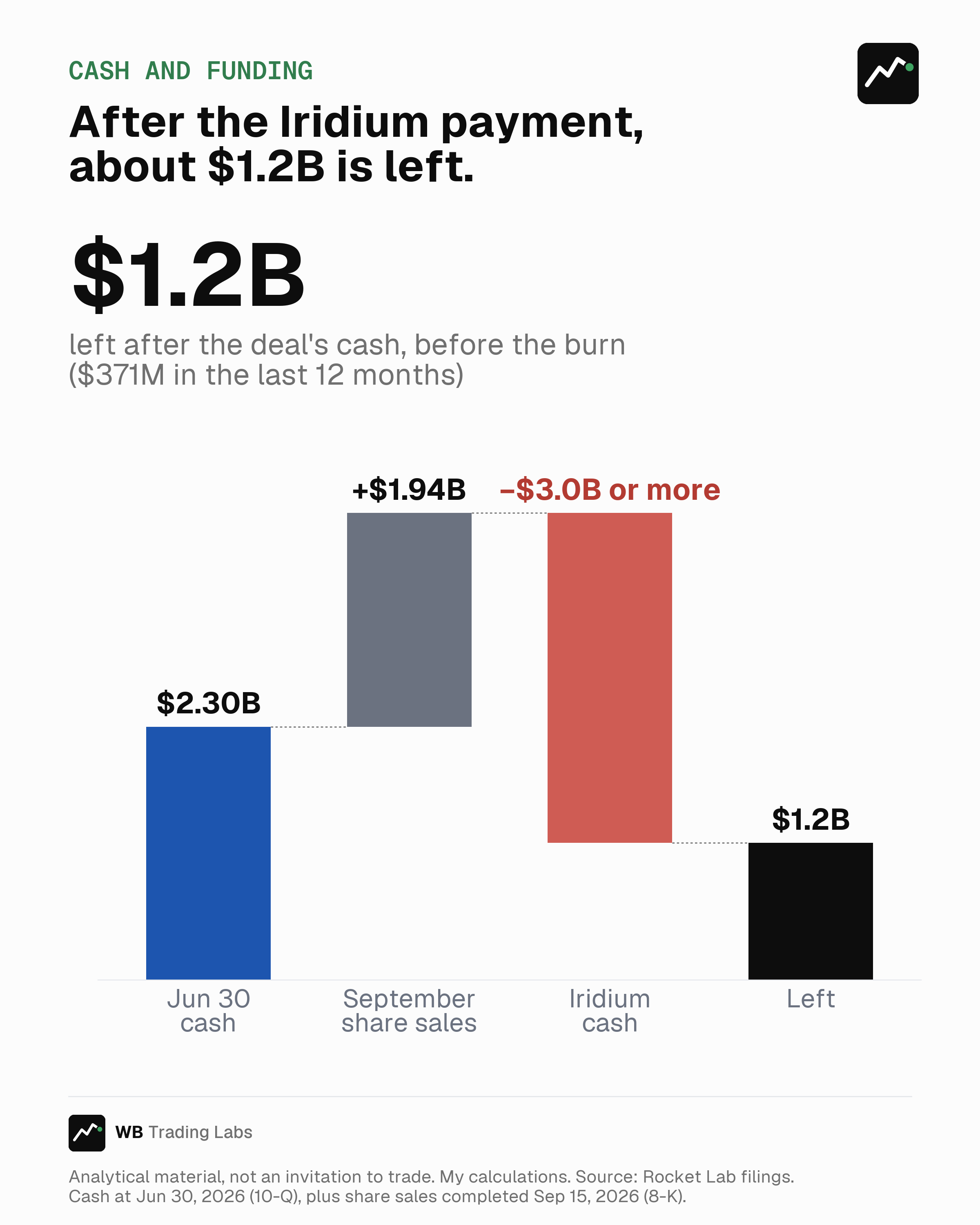
At the end of June Rocket Lab had $2.30B in cash and short-term investments; share sales completed on 15 September added $1.94B. Buying Iridium, the satellite phone and data network, takes "over $3.0 billion" in cash at closing, expected mid-2027. On my sum that leaves about $1.2B, before the cash Rocket Lab uses until then ($371M over the last 12 months).
Iridium brings its own cash: $134M of free cash (after equipment spending) in the first half of 2026, while Rocket Lab used $188M in the same half. Rocket Lab also takes on Iridium's $1.8B loan, which isn't in the sum.
Sources: 10-Q, June 2026; 10-K for 2025; 8-K, 15 Sep 2026; Iridium 10-Q, June 2026.
The share count
About 668M shares now, counting 41M preferred shares held by the CEO, which the company counts with its ordinary shares: a third more than at the end of 2024, mostly from debt turning into shares and from share sales. Acquisitions added about 5M.
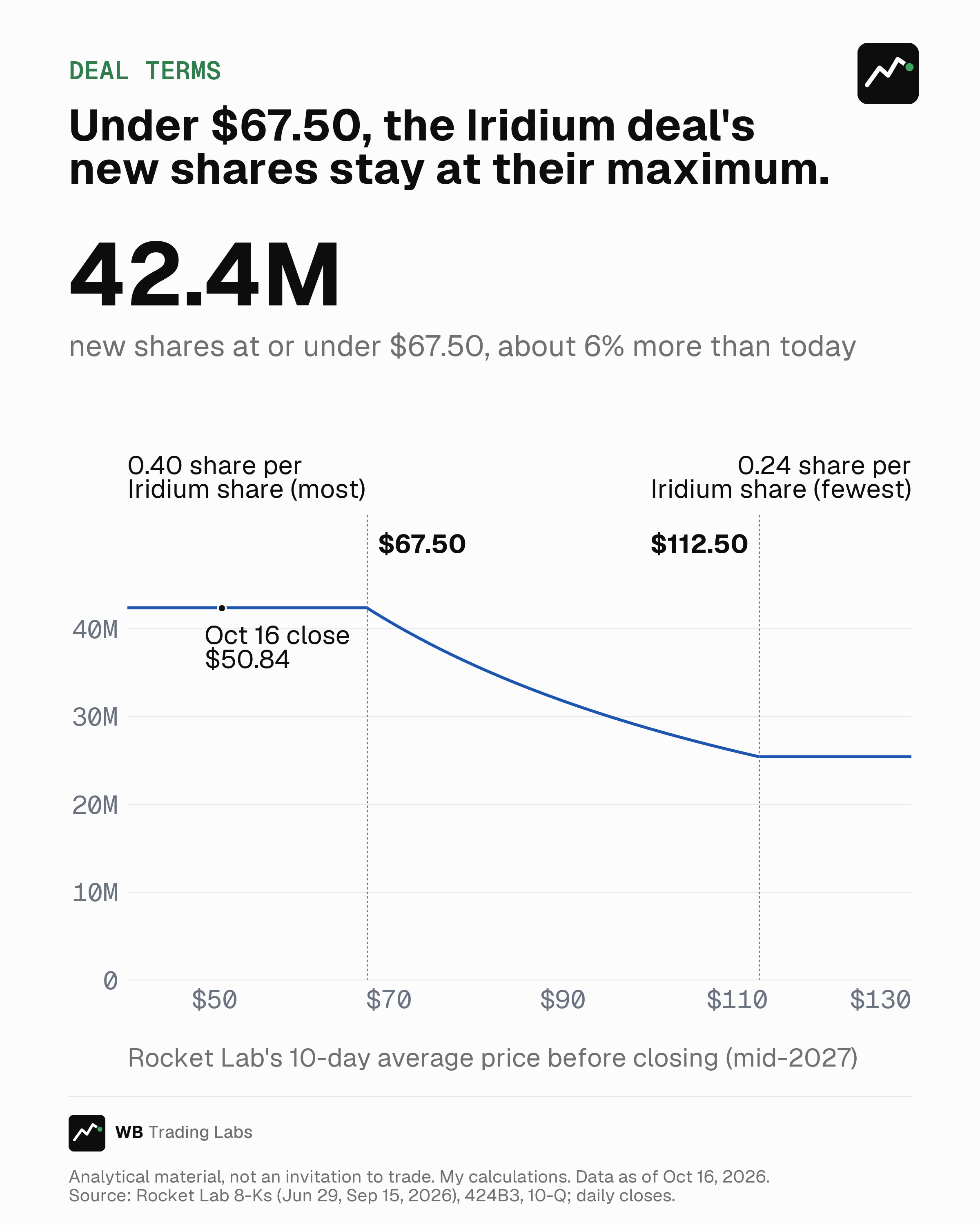
Iridium holders get $27 in cash plus $27 in Rocket Lab stock while Rocket Lab's 10-day average price before closing is between $67.50 and $112.50. Below $67.50 the new shares are capped at 42.4M, so the deal's dilution can't grow and Iridium holders take the fall: at the 16 October close ($50.84), their payout would be about $47, not $54.
Sources: 10-Q, June 2026; 10-K for 2025; Iridium deal prospectus; 8-K, 15 Sep 2026.
Shares still to come
What's still to come, against about 668M shares now. Already committed: up to 6.3% for Iridium at closing (mid-2027), 1.1% from 7.5M shares already sold forward: delivered by April 2028 for $474M to $642M, depending on the share price then, and 0.4% from the last convertible debt (loans that can turn into shares). That's about 8%.
If staff shares keep their 2025-26 pace (10-12M a year), add about 2.5% by spring 2028: about 10% in all, before any new share sale. No new share sale is filed now; the last of five sale programmes since March 2025, each replacing the one before, ended on 15 September.
Sources: Iridium deal prospectus; 8-K, 15 Sep 2026; 10-Q, June 2026; 10-K for 2025.
What comes next
Three things come next. First, the third-quarter report. Rocket Lab hasn't dated it yet; last year's came on 10 November. In August the company guided $250-265M of revenue for the quarter (the second quarter was $234M). The report will show the new share count and whether Rocket Lab puts a cost on the delay.
The US Government Accountability Office has until about 20 December to decide on Rocket Lab's protest, filed on 11 September, against NASA giving Blue Origin the Mars Telecommunications Network contract, worth about $700M, which would add to Rocket Lab's backlog only if it won a redone evaluation. In September I estimated about a 30% chance that NASA redoes the evaluation (not that Rocket Lab wins it). GAO upholds about 14% of the protests it decides; I put it higher because Rocket Lab says the award "appears to be inconsistent with the eligibility criteria mandated by Congress". I haven't updated that estimate since my September post.
Then the FCC and foreign approvals the Iridium deal still needs.
Sources: 8-K, Aug 2026; 8-K, Nov 2025; Iridium 10-Q; Rocket Lab on X, 11 Sep; GAO data.
This page started as a thread on X.
Missing a number, or spotted something wrong? Tell me on X or by email.